We are

Broadway has a long history of being a heavily trafficked corridor traversing the length of Manhattan, and over the years has hosted pedestrians, horses, bicycles, carriages, cable cars, automobiles, buses and the subway below. This year, the Initiative was excited to recently see data that confirmed that the district’s foot traffic has well surpassed pre-pandemic highs. Broadway crowds are nothing new, and this month our Look Back article explores a proposed method to alleviate congestion in the district from over 150 years ago. Read on to learn more!
Egbert Ludovius Viele was an engineer and Civil War veteran who had big ideas for New York. In addition to working on Central and Prospect Parks with Frederick Law Olmsted, he also created what has come to be known as the Viele Map, illustrating drainage and topography in Manhattan. In the 1860s and 1870s, he set his sights on improving intense congestion on Broadway with an ambitious plan called the Arcade Railway.

“Sanitary & Topographical Map of the City and Island of New York (1865)”, known as the Viele Map
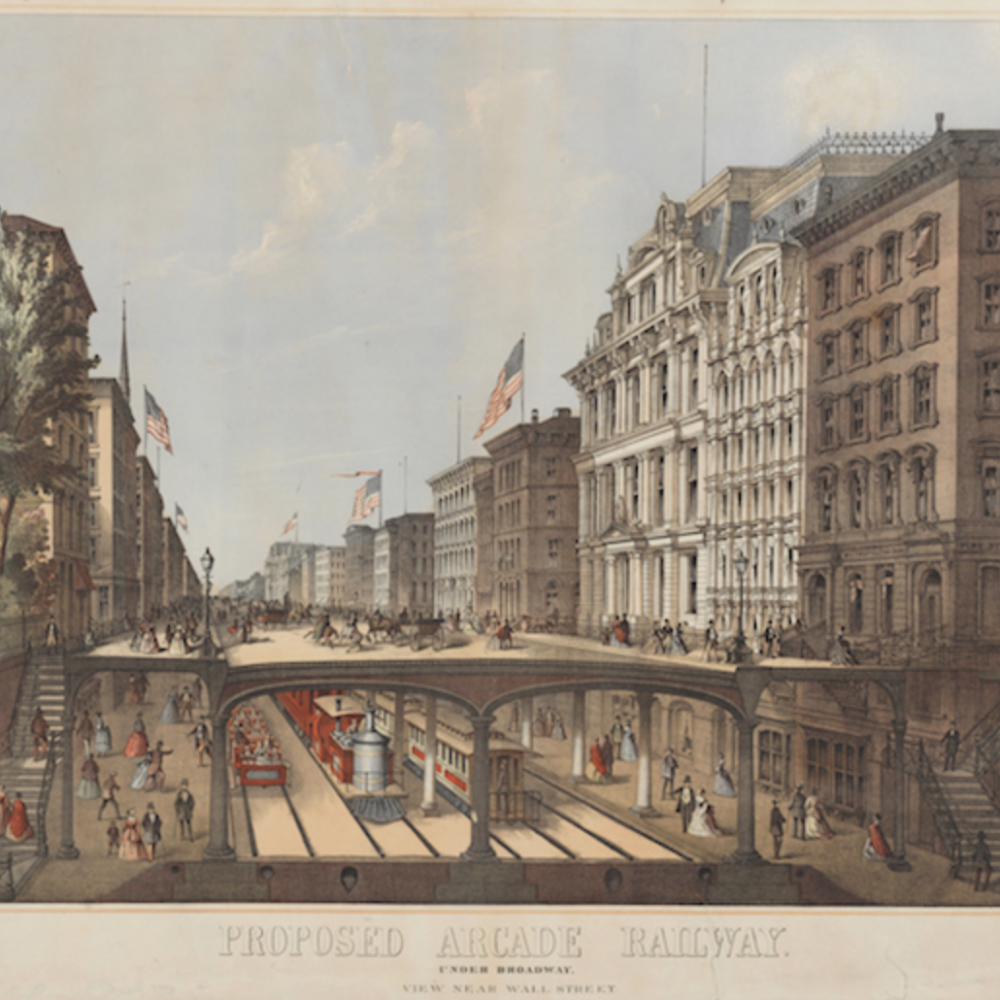
Viele proposed putting four railway tracks under Broadway, and adding subterranean sidewalks and stores along the tracks. Viele planned for two sets of tracks, running north and south respectively. One track in each direction would make local stops, while the other would make would stops that were further apart to enable faster travel through the city. The Arcade Railway plan, which Viele first proposed in the late 1860’s, was in many ways a precursor to the concept of our current subway system, which would not open until 1904. In a city as densely populated as New York, Viele said:
“[We] have so crowded the thoroughfares and overburdened the means of transportation, that there is an imperative and universal demand for relief, while a settled conviction pervades the public mind that this relief can only be afforded by the construction of a sub-surface railway.”

While Viele did predict the best place for trains in New York was underground, there were a number of notable differences between the proposed Arcade Railway and the current subway system. Viele proposed open cuts in the tunnel roughly every half mile that would be about 350 yards long for ventilation. Wide openings every half mile would have created a very different train system than the one we know today. Additionally, the Arcade Railway was proposed to have underground stores and walkways along the length of the tracks, essentially creating a second underground street.

Unfortunately for Viele, the Arcade Railway never came to fruition. Although funding and expanded rights were awarded to the Arcade Railway Company by the New York State Legislature, the measure was vetoed by Governor David Hill in 1885. The project faced significant opposition from some wealthy New York families, including the Astors, who feared the project would impact their property values. However, it is possible that the plan had an impact on shifting public opinion about underground travel, and paved the way conceptually for our subway system.
Although Broadway doesn’t house any underground stores as Viele proposed, it does shelter significant transit in New York. Our district has access to 11 trains at 3 subway stations, many with tracks that run under or intersect Broadway. Cities take time to respond to social and economic pressures and the development of new technology, as seen by the decades between Viele’s proposal and the subway’s ultimate construction. Although Viele’s specific vision never came to light, it is clear that the proposal put trains underground worked out well for New York in the long run!
Egbert Viele, Public domain, via Wikimedia Commons
Ford, Mayer & Sons and John M. August Will, Proposed Arcade Railway under Broadway near Wall Street, 1869. Museum of the City of New York, 29.100.2400.
Viele, E. L. 1825-1902. (1872). The Arcade under-ground railway: report of Egbert L. Viele, engineer in chief … [New York]: [Arcade Under-Ground Railway].