We are

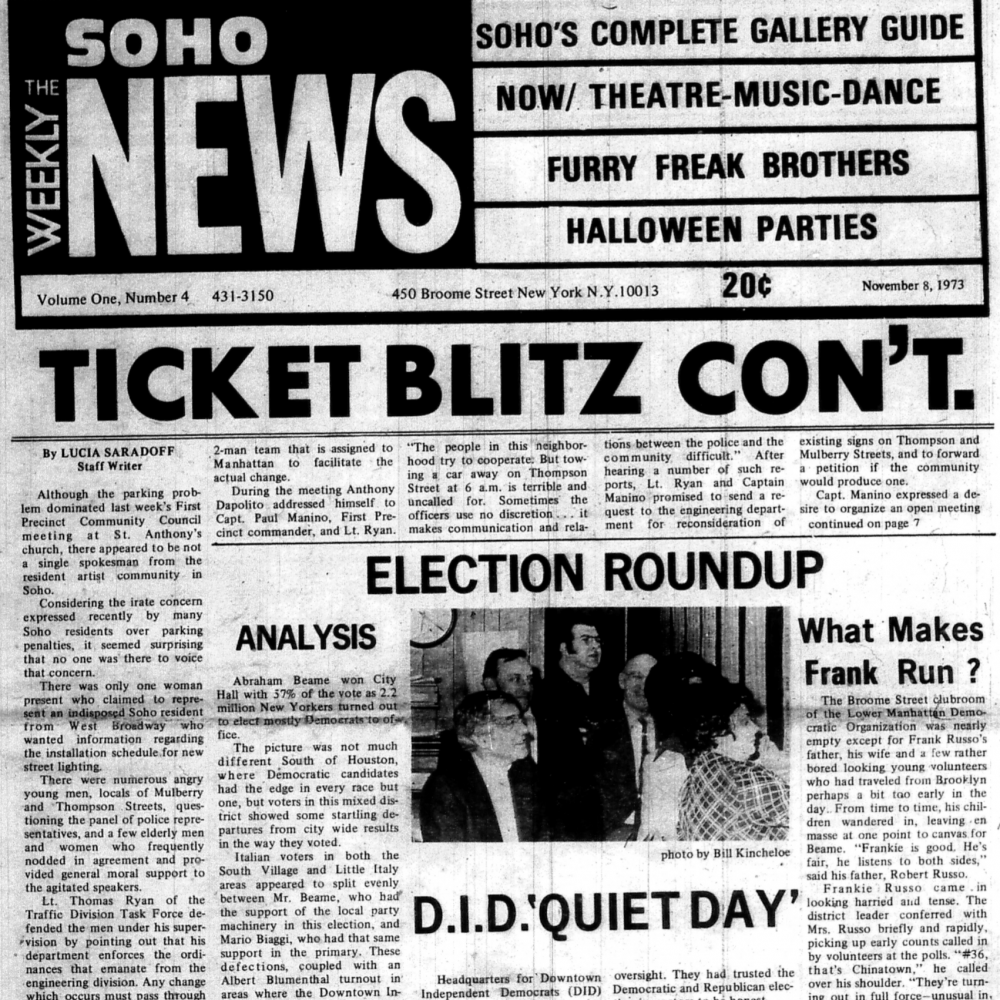
On the occasion of New York City’s 111th (or 112th?) mayor being elected last month, the SoHo Broadway Initiative sought to excavate election days of Novembers past as they were viewed locally. We turned to articles in the SoHo Weekly News, which reported on politics, fashion, business, theater, art, and trends in SoHo and New York City at large from 1973 to 1982. This time period spanned three mayoral elections, which took place in 1973, 1977, and 1981. Past issues of the SoHo Weekly News are available to the public at the New York Public Library on microfiche.
The election of 1973 offered a wide-open field after two-term mayor John Lindsay declined to run a third time. After a close primary race that required a runoff, Abe Beame won the Democratic endorsement and emerged as a frontrunner for mayor. Beame had made a name for himself after a career of public service which included a stint as City Comptroller at the time of the election. On November 6, 1973, just under a million New Yorkers delivered Beame the election win with over 56% of the vote, beating out Republican John J. Marchi, Liberal Albert H. Blumenthal, and Conservative Mario Biaggi.

In SoHo, many residents turned out for Democratic candidates, electing Paul O’Dwyer as City Council President and Harrison “Jay” Goldin as Comptroller with over 60% of the local vote. But the district diverged with the city in the mayoral race, turning out for Blumenthal and Biaggi in higher numbers than the rest of the city and with Beame securing only a plurality of the vote.

The article speculates that the higher number of votes for Biaggi likely came from Little Italy, which was in the voting district. The higher number for Blumenthal was likely due to a lack of enthusiasm for Beame among more liberal Democratic voters. The Downtown Independent Democrats, a political group which organized in SoHo, were distinctly unimpressed with Beame’s policies, and had a cynical view that his position as frontrunner for mayor was due to people feeling indebted to his long career in public service rather than out of a belief that he would be a good leader. As one club member put it: “The D.I.D. energies usually come from high convictions about the candidates and not because somebody’s pocketbook, prestige or power are at stake. And for that reason this has been a quiet campaign. Nobody has turned us on.” The New York Times, whose editorial staff endorsed Blumenthal over Beame, explained the reasoning behind their decision. “The (mayoral) office is too important to be viewed as an honor to “cap” a career, a phrase often used by those urging votes for the 67‐year‐old Mr. Beame.”
The 1977 mayoral election saw the city reeling from financial crisis, where Beame was forced to cut programs and jobs to compensate for the City’s debts. His lack of popularity led to a crowded race without a clear frontrunner. The Democratic primary was close, but Ed Koch, a Congressman at the time, beat NYS Secretary of State Mario Cuomo by a little more than 1%. Since both failed to garner more than 40% of the vote, they went to a run-off, which Koch won 55-45%. Despite losing the run-off, Cuomo stayed in the race on the Liberal Party line, but ultimately lost to Koch. There is an interesting parallel in how Mario Cuomo’s experience was mirrored by his son, Former Governor Andrew Cuomo, in the 2025 mayoral election. He also ran on a third party line after losing the Democratic primary and ultimately lost the general election.
The SoHo Weekly News saw Koch as a potential ally for the neighborhood, and highlighted how his support of the arts could benefit the area. As a US Representative for the East Side of Manhattan, Koch brought the concerns of artists to the nation’s capital and fought for artists’ issues. The SoHo Weekly News noted that Koch had visited SoHo a number of times to show his support for artists, including attending Artists’ Day, when many of SoHo’s streets were blocked off to traffic to make room for free art exhibits, performances, and events.

The article notes that Koch did not just see the arts as important for their own sake, but also as a tool for economic growth. Koch’s arts statement highlighted how the arts can play a role in increasing real estate values, and notes SoHo and Lincoln Center as examples of this phenomenon.
The 1981 mayoral election was virtually over after the primary, when Ed Koch won both the Democratic and Republican nominations. Although he faced some third party challengers, Koch handily won the general election with over 74% of the vote.

In addition to a somewhat meandering article on whether Koch upholds the Athenian standard of morality for cities, the early November issue of the SoHo Weekly News in 1981 also mentioned a name much more associated with the most recent mayoral election. Curtis Sliwa was quoted several times in an article on Lisa Evers, who had recently taken the number-two leadership position at the Guardian Angels. Titled “The woman and ‘the Rock'”, referring to a moniker Sliwa held in the 1980s, the article gives an overview of their relationship and Evers’ role in the Guardian Angels’ leadership.


Although they both deny romance rumors in the article, the two would wed on Christmas Eve later that year. The piece gives an overview of Evers’ rise through the Guardian Angels’ ranks while identifying some inconsistencies in Evers’ backstory, including her age and where she went to college. The article exemplifies Sliwa’s long history of appearing in New York’s headlines.
We at the SoHo Broadway Initiative wanted to share a note of thanks to the New York Public Library Archives which provides resources for us to connect our present to our past. Their stewardship of past issues of the SoHo Weekly News allows us to peer into historic events through a local lens. We appreciate the greater understanding of our District’s history these valuable public resources can offer to all of us!