We are

Today, the SoHo Broadway district benefits from dense transit options that operate 24/7. The Prince Street station, Broadway-Lafayette station, and Canal Street station provide those traveling to and from the district direct access to the B, D, F, J, M, N, Q, R, W, Z, and 6 trains. However, this has not always been the case. Before the turn of the 20th century, people coming to SoHo to work in the many textile factories or access the other warehouses mostly would have arrived on foot or via horse-drawn means such as streetcars. Although what has become the SoHo area had a history of residential use, by the early 1900s the neighborhood was primarily industrial and commercial. Deliveries, commuters, and through traffic including horses, wagons, cars, and pedestrians were all packed onto chaotic streets.
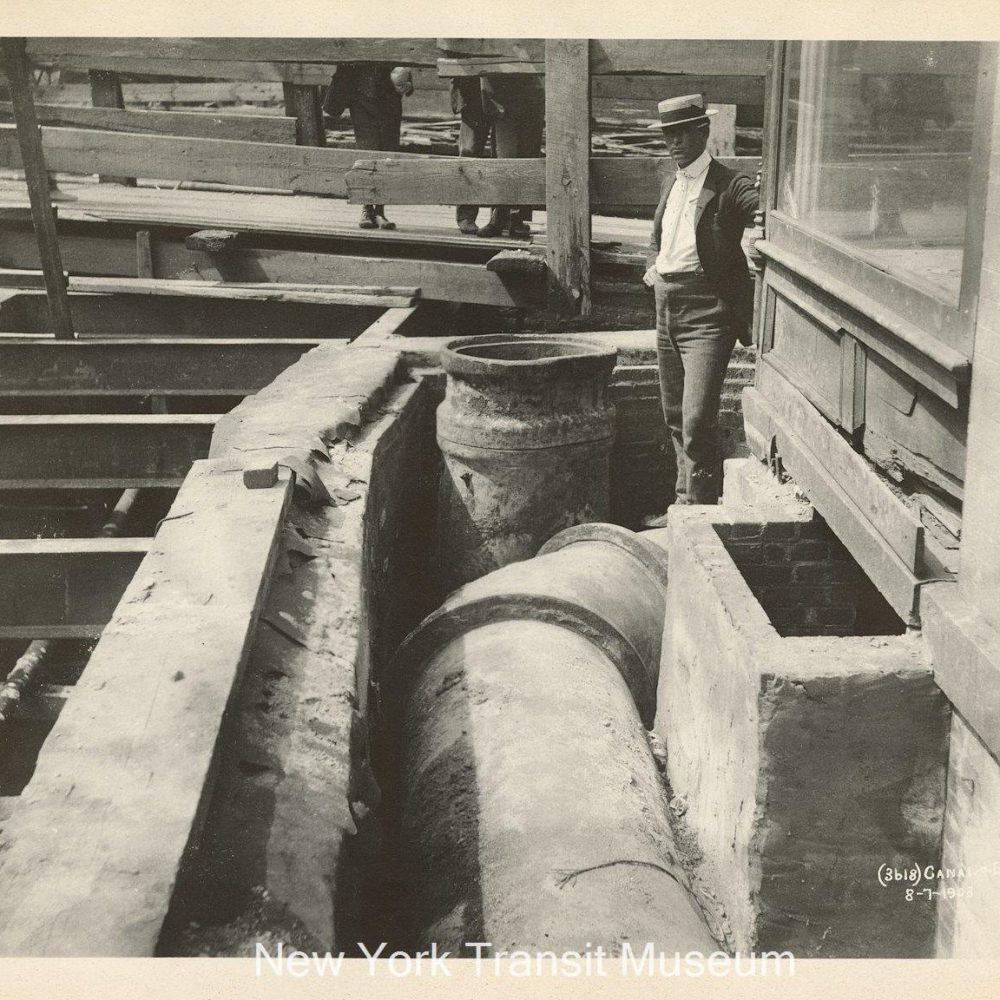
The Canal Street station brought subway service to the district, and was one of the first 28 stations of the New York City Subway constructed by the Interborough Rapid Transit Company (IRT). Before it could open to the public, builders first had to contend with the high water table and the remnants of nearby Collect Pond. Builders held off on constructing Canal Street station because they anticipated challenges with flooding, soft soil, and quicksand. Luckily for construction, the soil had a higher gravel content and was more solid than anticipated. However, there was still excess water to contend with; pumps had to run continuously to allow work to proceed. Workers found many artifacts in the muck under the street and in the old canal, including coins, keys, tools, and bones.
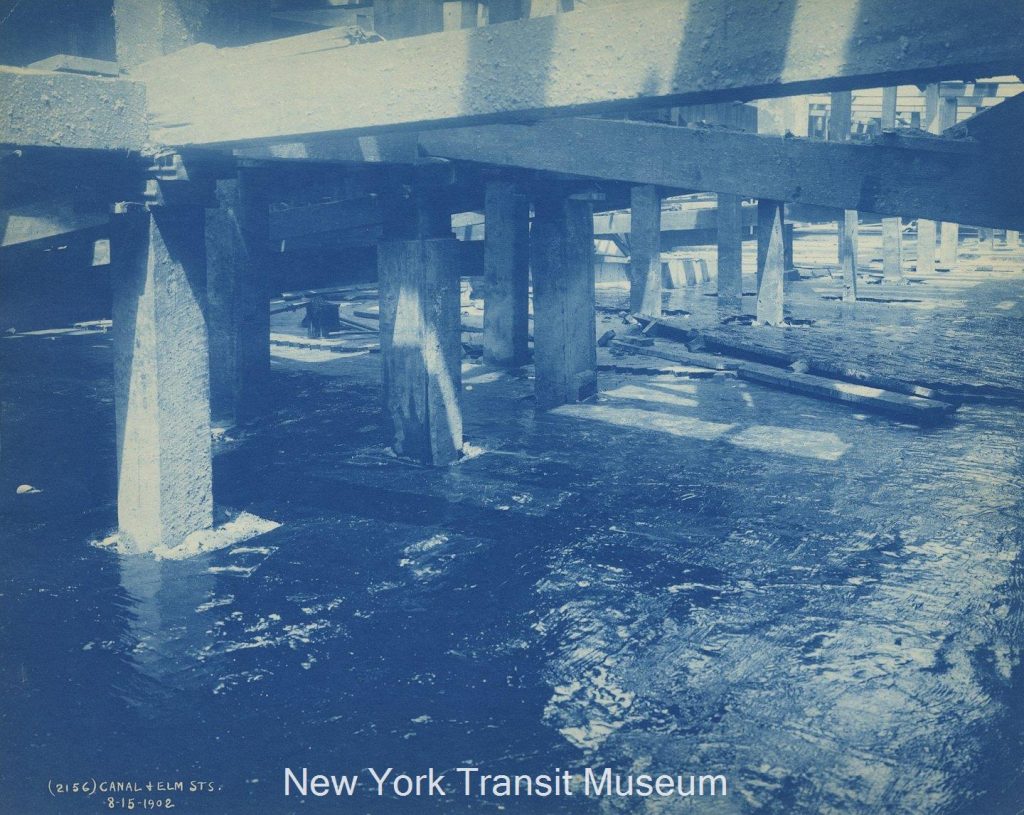
8/15/1902 photo showing an excavated pit and wooden scaffolding on Canal St and Elm St (now Lafayette St). Water is flowing on the ground, showing the issues builders had to contend with to complete the station. Courtesy of the New York Transit Museum Archives.
The station successfully opened in October of 1904, and quickly became popular. In 1909, only a year after the IRT line was fully completed, the New York Public Service Commission sought to expand the platforms to accommodate heavy use. This pattern of expansion would continue, adding multiple lines and platforms to the station complex over the next couple decades. Overcrowding continued, and it became clear that more stations in the area were needed to handle the demand.
Heavy use of the existing IRT stations at Canal Street, Spring Street, and Bleecker Street led to calls for more stations in what is now the SoHo area. Many workers used the Interborough line to get their jobs at local warehouses. The Prince Street station opened in September of 1917 and provided alternative transit options for commuters. As part of the new line developed by the Brooklyn-Manhattan Transit Company (BMT), Prince Street station was part of a network connecting train lines in Brooklyn to Manhattan. The New York Times praised the new line for both relieving congestion on the Interborough lines and how it would “tap the area of big loft buildings where many thousands of people work”.

07/12/1917 Photo of nearly finished Prince St station. Courtesy of the New York Transit Museum Archives.
The new BMT line would provide faster, cheaper service for local workers and other train users. Transit riders coming to what is now SoHo from Brooklyn, as many factory workers did, would be able to decrease their transit spending by half. The new Broadway line charged 5 cents per ride, while the older Interborough line charged 10 cents. At peak times, trains came every three minutes. The new line proved very popular, and within ten years the New York City Board of Transportation sought bids to expand the station. The new longer platforms would be able to hold 8 cars instead of 6, increasing capacity by 126,000 riders per day.
In 1936, subway transit options in what would become the SoHo Broadway district were further enriched by the opening of the Broadway-Lafayette station on the new municipally owned Independent Subway System (IND) Sixth Avenue Line.
Today, the three subway stations within the district’s boundaries (Broadway-Lafayette, Prince Street, Canal Street) provide over 20 million rides per year. Like all stations in the pandemic, ridership dropped dramatically in 2020. However, SoHo Broadway’s ridership has shown resilience and have rebounded over the past few years. The citywide average ridership is at 70% of pre-pandemic levels, and all stations in the area are at least at that benchmark if not above. Canal Street station had 11 million trips in 2024, which is 70% of pre-pandemic levels and a 226% increase over 2020 lows. Prince Street station had over 3 million trips in 2024, putting it at 74% of pre-pandemic levels. Broadway-Lafayette is leading the recovery charge, and as of 2024 it was at 80% of its 2019 ridership with nearly 10 million rides.
Preliminary data from 2025 is even more promising, with all three stations having increased ridership from 2024 and closing in on the 2019 average. These climbing numbers show how SoHo Broadway’s stations continue to carry people where they need to go, as they have faithfully done for over 100 years.